

Biodiversity Program
. PGE has developed and implemented a Biodiversity Action Plan (BAP) by conducting a Biodiversity Action Plan (BAP) Study across its geothermal working areas. The formulation of the BAP is prioritized for areas directly adjacent to protection forests and Natural Tourism Park (TWA) regions, while other operational areas continue to be managed through applicable environmental management frameworks. Areas that have established a BAP include the Lumut Balai, Kamojang, and Karaha Areas. The basis for determining BAP study locations over the past 3 years is their location within protection forests and Natural Tourism Park (TWA) forests, which feature high biodiversity index values. Even before the formal BAP was drafted, PGE had already implemented various biodiversity management recommendation programs in these areas. The BAP is formulated to align and provide a solid foundation for ongoing programs with prevailing national regulations. The BAP document integrates biodiversity risk assessments, critical habitat mapping, and conservation planning. This plan explicitly applies the mitigation hierarchy and is aligned with national and international standards, targeting No Net Loss (NNL) to Net Positive Impact (NPI). As a baseline, PGE adopts internationally recognized mitigation hierarchy frameworks, such as: IFC PS6, WB-ESS, IPIECA, and Equator Principles. In addition, all biodiversity management achievements and performance have undergone an independent verification process using the AA1000 assurance standard to ensure data transparency and accountability.
The implementation of the mitigation hierarchy includes habitat restoration activities, reforestation using endemic species, and community engagement. Furthermore, the implementation and management of these activities take into account the IUCN Red List, CITES, Minister of Environment and Forestry Regulation No. P.106 of 2019, as well as the scope of management and monitoring outlined in the Environmental Impact Assessment (AMDAL), Environmental Management Plan (RKL), and Environmental Monitoring Plan (RPL) to ensure compliance and best practices.
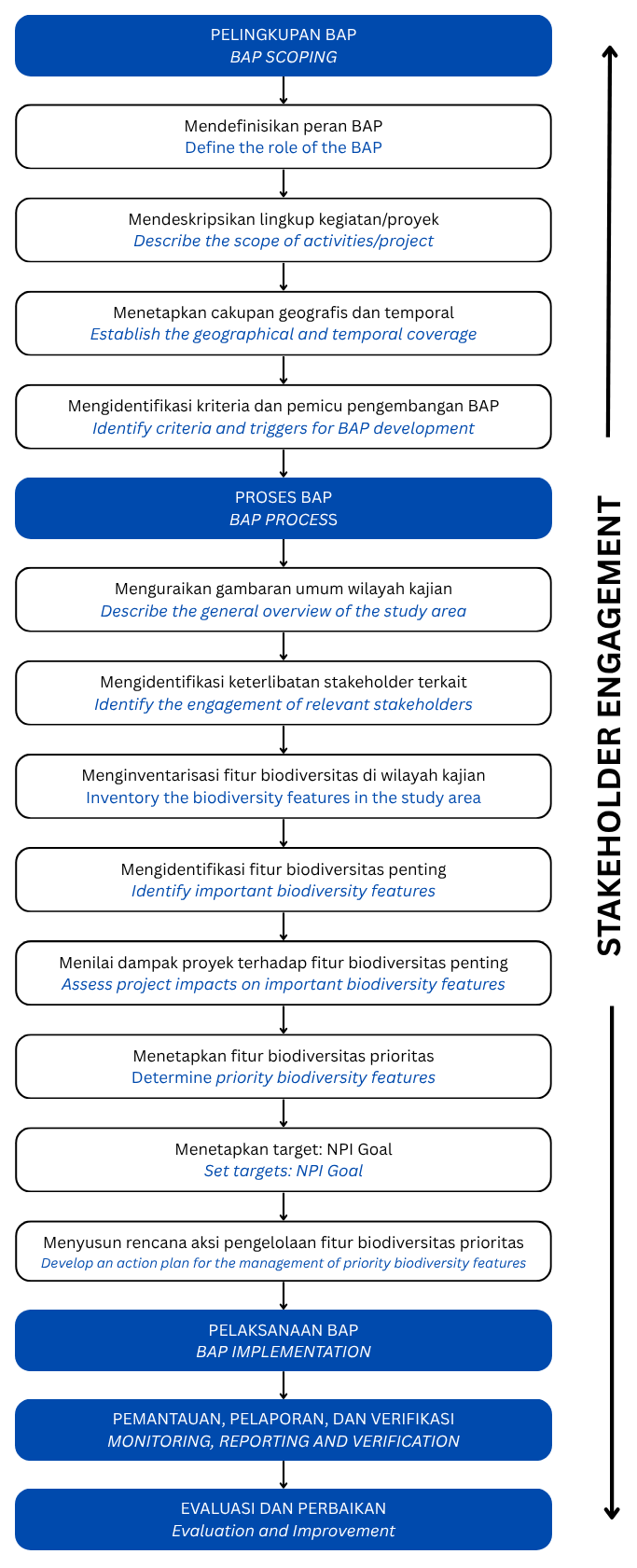
Flowchart of BAP Development and Implementation to Achieve Net Positive Impact (NPI)
The implementation of the mitigation hierarchy is carried out through four primary stages:
- Avoidance – designing survey routes and drilling locations to ensure operations do not cross key natural habitats, by directing activities to already-modified land areas;
- Minimization – restricting work areas and access, utilizing existing pathways, and applying environmentally friendly technologies, establishing buffer vegetation, and controlling pollution in sensitive areas;
- Restoration – rehabilitating degraded habitats through reforestation using native and/or threatened species, improving vegetation structure, developing ecological corridors, and restoring impacted land a reas; and
- Offset – undertaking restoration or rehabilitation activities outside the project area to compensate for unavoidable impacts, accompanied by Additional Conservation Actions (ACA) such as research initiatives and conservation programs for threatened species.
Based on the BAP assessments conducted in the Lumut Balai, Kamojang, and Karaha areas, the following are key mitigation hierarchy activities that form the biodiversity management action plans across these locations:
Lumut Balai:
- Control of invasive plant species with the involvement of surrounding communities.
- Conservation programme for endemic Nepenthes (Pitcher Plant) and Orchid species listed under CITES, with a target for in-situ conservation at the Kolam Puyang Area.
- Regular monitoring programme using camera traps to observe the status of rare and protected wildlife, including Sumatran Tiger, Tapir, and Sun Bear.
Kamojang:
- Conservation of Saninten, an endemic flora species classified as Endangered on the IUCN Red List, with a population decline of approximately 50% over the past three years.
- Conservation of Javan Surili, a Vulnerable species (IUCN Red List) facing threats from illegal hunting and habitat fragmentation.
- Conservation of Javan Hawk-Eagle (Nisaetus bartelsi, EN) through the Kamojang Eagle Conservation Center (PKEK), managed in collaboration with relevant conservation agencies.
- Forest revegetation and irrigation system improvement as part of efforts to achieve the Net Positive Impact (NPI) target in the Kamojang Lower Montane Forest.
Karaha:
- Protection of priority flora and fauna species listed under CITES Appendix I and II, alongside the designation of Natural Forest as the primary key ecosystem and identification of critical habitats through the EAAA method.
- Rehabilitation of primate ecological corridors and strengthened protection of Javan Leopard habitat against illegal hunting threats.
- Multi-stakeholder engagement using the IAP2 Public Participation Spectrum approach, alongside an annual Monitoring, Reporting and Verification (MRV) programme with comprehensive evaluations conducted every 3–5 years.
At the project level, PGE implements an integrated mitigation hierarchy to minimize operational impacts while protecting surrounding ecosystems. This is demonstrated through engineering design solutions, such as stacked steam pipeline designs in conservation forest areas that significantly reduce land clearing, as well as restoration programs including endemic species reforestation and watershed rehabilitation. Beyond managing impacts from internal activities, PGE proactively maps external threats to biodiversity through periodic biodiversity surveys including the risks of illegal hunting, encroachment, and the spread of invasive species. To mitigate these risks, PGE carries out comprehensive preventive measures encompassing environmental education and awareness campaigns, installation of anti-poaching signage, and strategic collaborations with forestry authorities, local communities, and community empowerment programs.