

Energy Efficiency
PGE is committed to sustainable energy management aligned with the Company’s Sustainability Policy and the Environmental Management Plan–Environmental Monitoring Plan (RKL-RPL) framework. This management strategy focuses on enhancing operational energy efficiency and optimizing the utilization of Renewable Energy (EBT). The Company has established a target for renewable energy mix of 96% for internal energy consumption by 2030, with the 2025 achievement increasing to 94.36%.
To realize this commitment, PGE continuously implements various operational efficiency initiatives. Key strategic measures executed throughout 2025 include the implementation of the Steam Redistribution and Adjustment Method (STREAM) program in the Ulubelu Area, alongside equipment optimization across operational sites in Kamojang, Lahendong, Karaha, and Lumut Balai. The implementation of these initiatives successfully achieved a total energy consumption reduction of 25,139.52 MWh a 125.92% increase compared to 2024—while securing an improved energy efficiency ratio of 0.0049 MWh/MWh.
To ensure the effectiveness and accountability of its energy efficiency implementation, the Company conducts periodic energy audits every three years. The latest energy audit results in January 2025 verified that the implementation of energy efficiency programs, operational cost savings, and energy utilization ratios across all PGE operational areas consistently demonstrate a positive and continuously improving performance. In addition, PGE raises awareness among employees and surrounding communities on energy management through socialization efforts and knowledge transfer of its various energy efficiency programs. In 2025, these activities were carried out in the Kamojang, Karaha, Lahendong, and Lumut Balai areas, and were attended by the respective Area General Managers. PGE also ensures the competency of personnel involved in unit efficiency, including energy managers, energy auditors, and energy efficiency team members from its 6 operational areas, through BNSP certification in energy management, as well as participation in energy efficiency training.
Greenhouse Gas Emission Reduction
Decarbonization Commitment and Emission Intensity Target
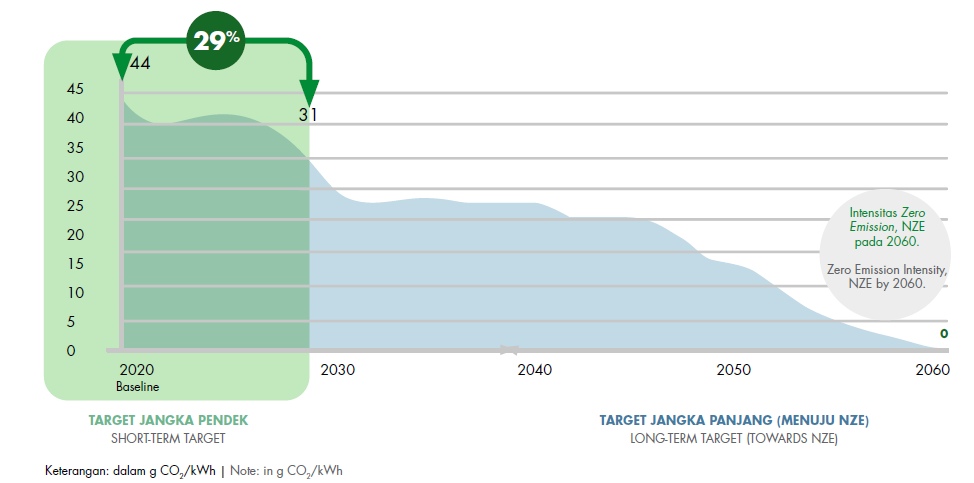
PGE is committed to supporting corporate decarbonization agendas and the Net Zero Emission target through a commitment to reduce GHG emission intensity by 29% by 2030, from the 2020 baseline of 44 g CO₂e/kWh to 31 g CO₂e/kWh. This commitment aligns with the decarbonization targets of PT Pertamina (Persero) as the Holding Company and PT Pertamina NRE (PNRE) to support global warming mitigation. PGE's emission intensity achievement in 2025 was recorded at 41.12 g CO₂e/kWh, well below the thresholds of the European Taxonomy and the Indonesian Sustainable Finance Taxonomy (100 g CO₂e/kWh).
Scope 1 Emission Performance
Scope 1 emissions, which originate from the venting of Non-Condensable Gases (NCG) during power generation processes as well as operational fuel consumption, were successfully suppressed to 89,909.24 tons of CO₂e in 2025, a 2.51% decrease compared to 2024 (92,222.91 tons of CO₂e). This reduction was partly driven by the debottlenecking and production well interconnection program in the Ulubelu Area, which successfully reduced NCG emissions by up to 40,272.31 tons of CO₂e.
Scope 2 and Scope 3 Emission Performance
Scope 2 emissions were recorded at 2,889.72 tons of CO₂e, experiencing an increase alongside the commencement of operations for the supporting facilities of the Lumut Balai Unit 2 PLTP (55 MW). Meanwhile, Scope 3 emissions were recorded at 162,190.82 tons of CO₂e due to increased procurement of capital goods for green business investment projects. To manage this supply chain emissions, PGE actively encourages vendors to conduct emission recording, supply chain efficiency, and the use of low-carbon fuels. Reduction Initiatives and Operational Innovation Emission reductions across all operational areas were realized through various technical and operational innovations. In addition to debottlenecking in Ulubelu, PGE utilized a Binary Power Plant in Lahendong (reducing 1,197.60 tons of CO₂e), operated solar power plants (PLTS) in the Lahendong and Kamojang Areas (20.99 tons of CO₂e), optimized gravity pumps in Kamojang (229.08 tons of CO₂e), electrified the logyard and clusters (200.52 tons of CO₂e), and utilized hybrid and electric vehicle fleets (73.27 tons of CO₂e).
Inisiatif Reduksi dan Inovasi Operasional
Penurunan emisi di seluruh wilayah kerja direalisasikan melalui berbagai inovasi teknis dan operasional. Selain debottlenecking di Ulubelu, PGE memanfaatkan Binary Power Plant di Lahendong (mereduksi 1.197,60 ton CO₂e), mengoperasikan PLTS di Area Lahendong dan Kamojang (20,99 ton CO₂e), mengoptimalkan pompa gravitasi di Kamojang (229,08 ton CO₂e), melakukan elektrifikasi logyard & cluster (200,52 ton CO₂e), serta memanfaatkan armada kendaraan hybrid dan listrik (73,27 ton CO₂e).
Emission Avoidance Contribution
As part of its low-carbon business, PGE provides a tangible contribution to the environment through the supply of clean energy with an emission intensity 95.43% lower than fossil fuel-based power plants. Throughout 2025, PGE's total electricity production of 5,095.49 GWh successfully avoided GHG emissions (emission avoidance) of up to 4,291,102.02 tons of CO₂e based on the ACM 0002 methodology.
Carbon Credit
PGE actively supports global decarbonization through the issuance and trading of carbon credits from geothermal projects that feature a carbon footprint up to 10 times lower than fossil fuel power plants (1 credit=1 tCO₂e), alongside ongoing research and development in Carbon Capture and Storage (CCS) and Carbon Capture, Utilization, and Storage (CCUS). PGE solidified its position as a pioneer by becoming the first carbon credit provider on the Indonesia Carbon Exchange (IDXCarbon) in September 2023 through the Lahendong Unit 5 & 6 project, and has been actively supplying the international market since 2022 under the Clean Development Mechanism (CDM) scheme for Ulubelu Area Units 3 & 4 (1,549,663 tCO₂e) and Karaha Area Unit 1 (192,809 tCO₂e). The strength of PGE’s carbon portfolio is reinforced by achieving Gold Standard CER certification—the first certification in Indonesia’s geothermal sector demonstrating compliance with sustainability criteria that encompass stakeholder engagement, human rights respect, biodiversity conservation, and community empowerment.